Water Management Solutions

Composite Waterproofing System (CWS)
Strucproof’s anchor product: a performance-driven, composite waterproofing rehabilitation system engineered for long-term protection of below-grade and water-exposed structures.
Performance-Driven
Developed around watertightness, vapor tightness, durability, and repairability.
Negative-Side Capable
Applied from the interior, ideal when the positive side cannot be accessed.
Crack Accommodation
Fiber-reinforced composite absorbs substrate movement and deformation.
Repairable & Maintainable
The system can be repaired if damage occurs during its service life.
overview
A new generation of waterproofing, engineered for structures that need protection now, not at construction time
Most waterproofing failures are not new construction problems. They appear later, when membranes have aged, when concrete has cracked, when groundwater conditions have changed, or when the original positive-side waterproofing has become permanently inaccessible. By that point, the traditional toolkit becomes limited: dig up the exterior at significant cost and disruption, accept ongoing leakage, or rely on injection grouting that may need to be repeated again and again.
Structight™ Composite Waterproofing System (CWS) was developed as the anchor product of the Strucproof platform, based on the proven Tectoproof technology from ETANDEX. It is a composite system engineered specifically to address rehabilitation conditions where traditional approaches fall short. The system delivers watertightness and vapor tightness from the negative (interior) side of the structure, while accommodating substrate cracking, bonding to damp concrete, and remaining repairable over time.
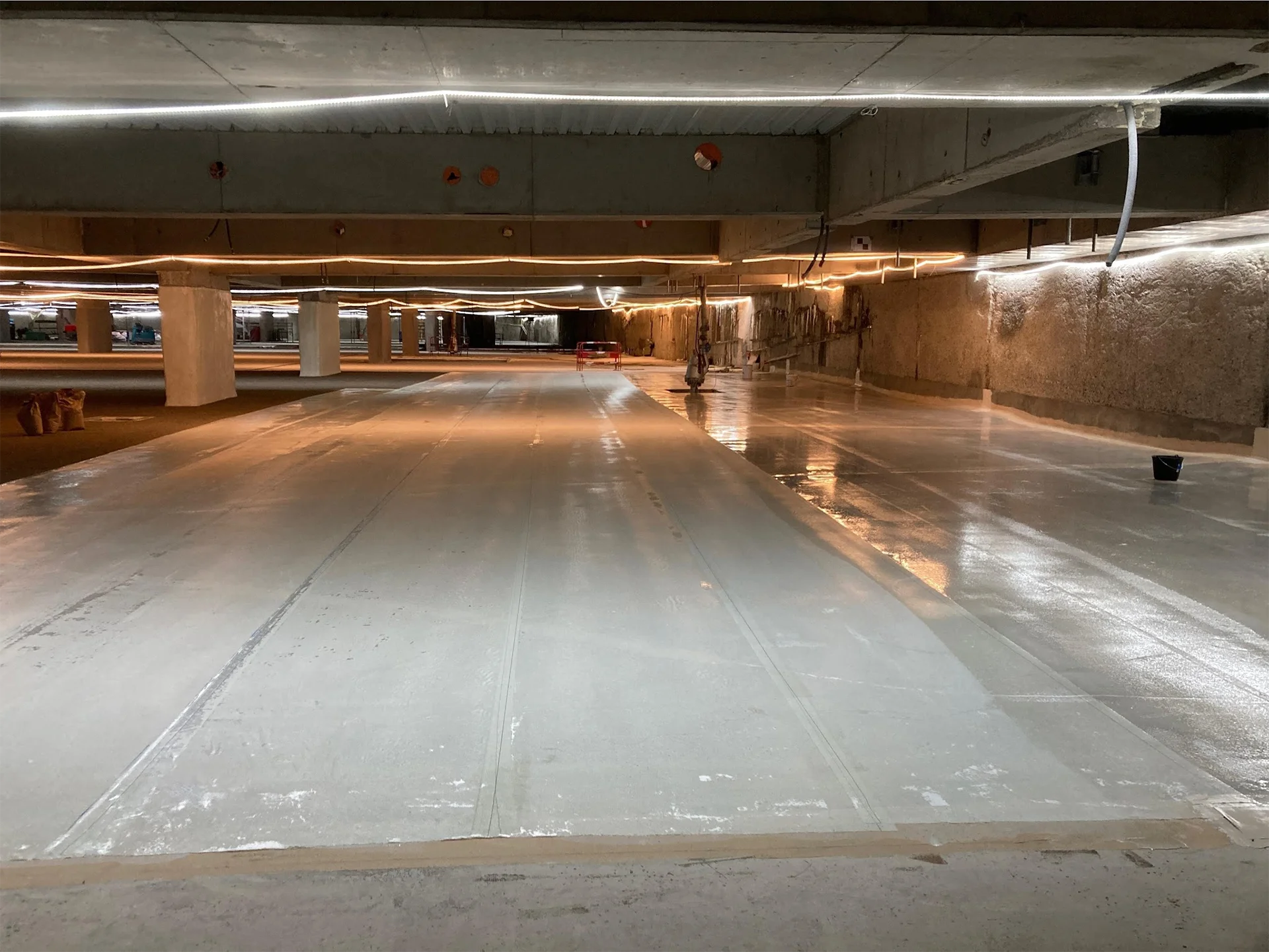
It is designed for the structures most owners actually have to deal with: aging basements, retrofitted underground spaces, water-exposed concrete in service, and below-grade conditions where the exterior is simply out of reach.
Every Structight™ CWS installation is backed by a 10-year warranty, giving owners long-term confidence in the rehabilitation.
Good fit when:
the challenge
Traditional waterproofing methods don’t solve every problem, especially after the structure is built
Below-grade structures face constant water pressure. Water finds its way in through cracks, joints, penetrations, honeycombs, and porous concrete, driven by hydrostatic pressure from surrounding groundwater. Once the structure is built and the surrounding soil is backfilled, the traditional toolkit for stopping this intrusion becomes limited.
Typical Paths for Water Ingress
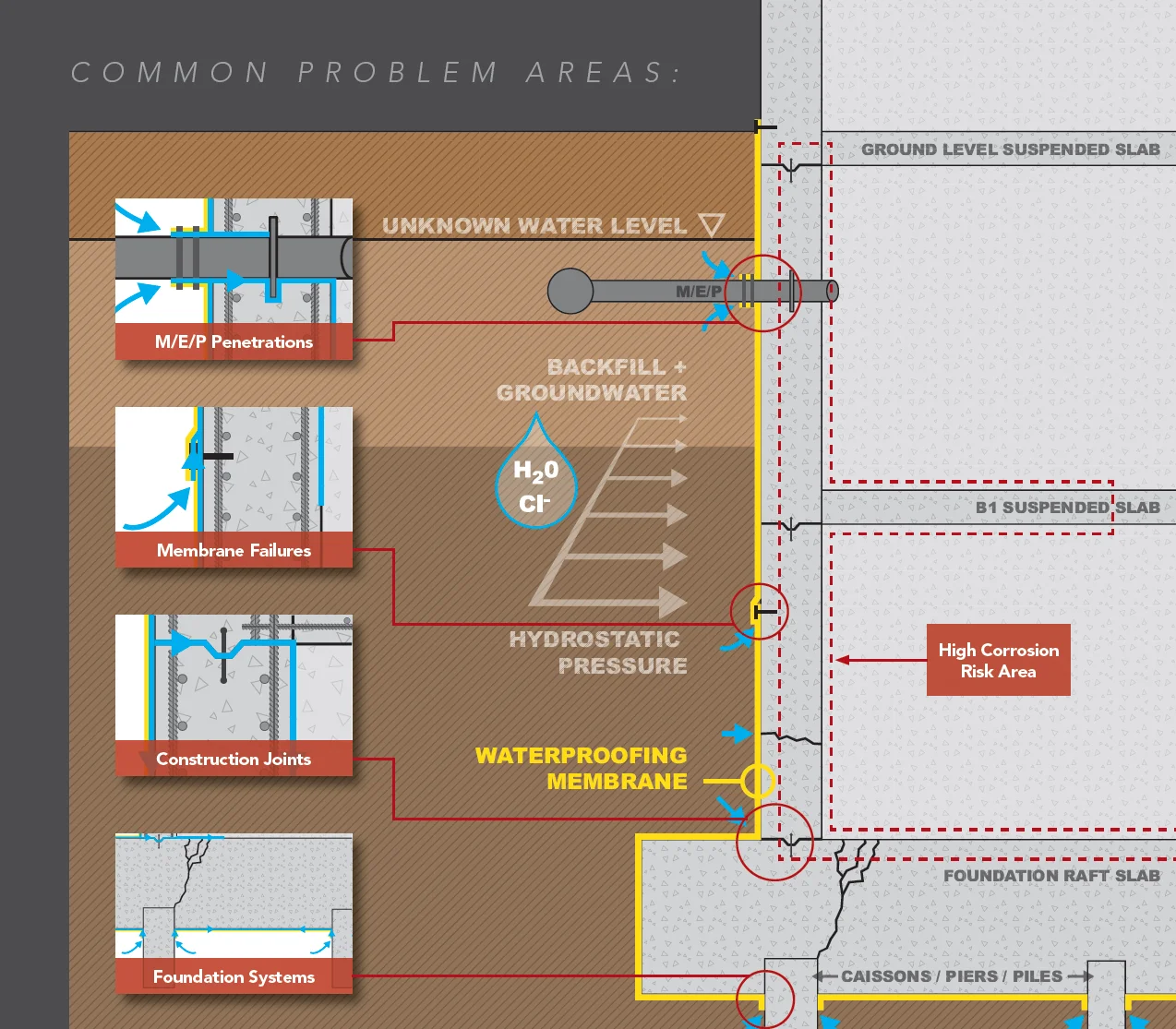
Conventional waterproofing comes in two flavors: positive-side (exterior membranes applied during construction) and negative-side (interior systems applied after the structure is built). Both have their place, but both have significant limitations in rehabilitation scenarios.
Limitations of traditional positive-side waterproofing
- Inaccessible after construction is complete
- Excavation cost and disruption to repair
- Can be damaged by backfill, ground movement, or biological activity
- Localized failures require disproportionate rework
- Difficult to repair in occupied or operational structures
Limitations of traditional negative-side waterproofing*
- Limited resistance to active hydrostatic pressure
- Poor crack accommodation, substrate movement causes failures
- Limited vapor protection
- Coatings can blister or delaminate under negative pressure
- Often relies on repeated injection grouting to address ongoing leaks
Structight™ Composite Waterproofing System was engineered specifically to address these gaps — combining the accessibility of a negative-side system with the performance characteristics historically associated only with positive-side membranes.
* Negative-side waterproofing is any waterproofing system applied to the interior (dry) side of a below-grade structure — the opposite side from where water is pushing against it. It is the only accessible option once a structure is built and its exterior is buried, backfilled, or otherwise unreachable.
System Comparison
How Structight™ CWS compares to traditional approaches
Across five core performance criteria, Structight™ Composite Waterproofing System is designed to deliver what traditional negative-side methods cannot, while remaining applied from the interior side of the structure.
| Performance Criterion | Traditional Negative-Side | Traditional Positive-Side | Structight™ CWS (Negative Side) |
|---|---|---|---|
| Watertightness | ✓ | ✓ | ✓ |
| Vapor Tightness | ✗ | ✓ | ✓ |
| Crack Resistance | ✗ | ✓ | ✓ |
| Ease of Application | ✓ | ✗ | ✓ |
| Repair & Maintenance | ✓ | ✗ | ✓ |
Structight™ CWS is the only approach that delivers all five performance criteria — including vapor tightness and easy maintenance — from the negative (interior) side of the structure.
System Architecture
A layered composite system engineered to perform under demanding conditions
Strucproof Composite Waterproofing System (CWS) is built as a multi-layer composite assembly. Each layer plays a specific structural and functional role, and together they create a system that bonds to the substrate, resists negative hydrostatic pressure, accommodates substrate movement, and supports long-term durability.
Layers & Descriptions
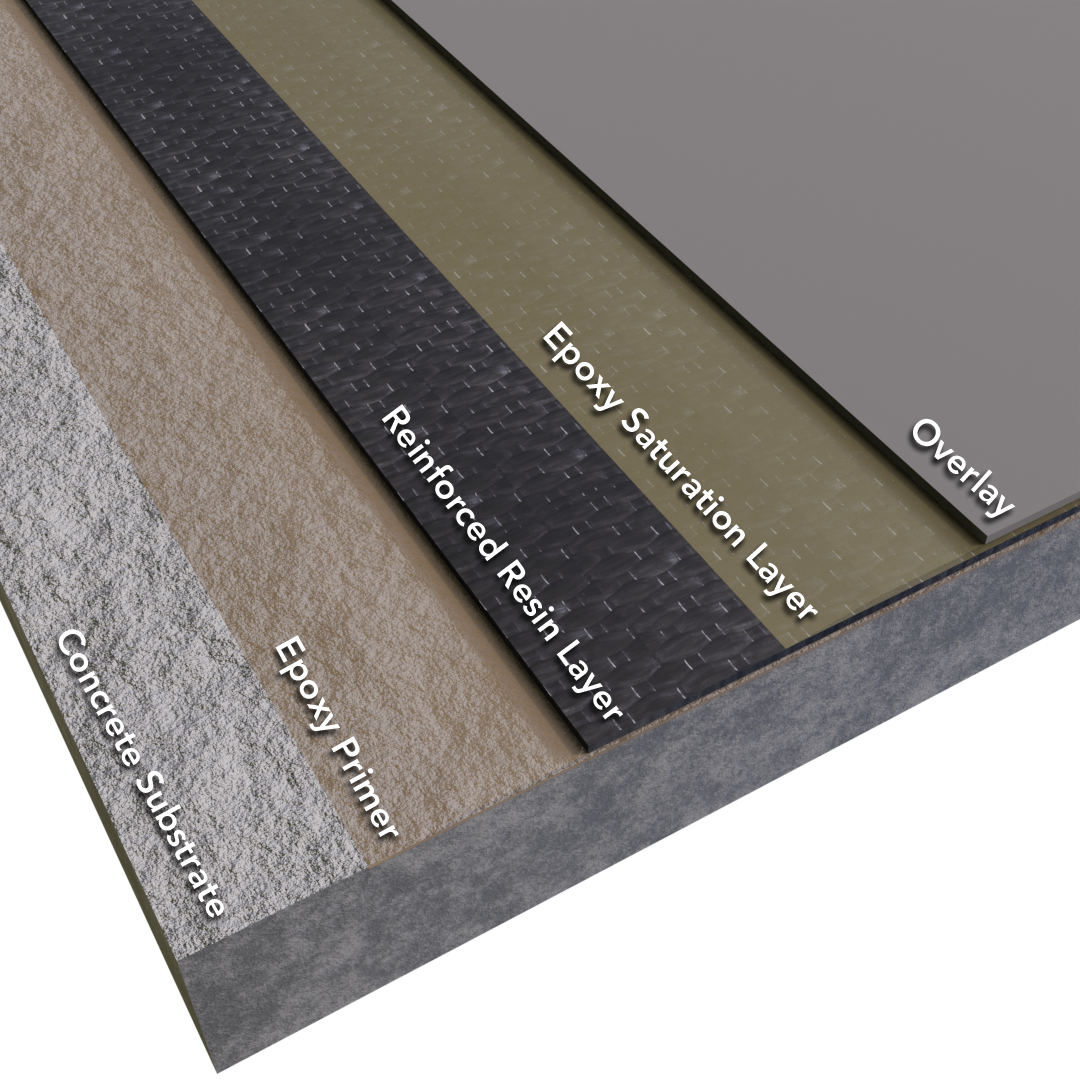
Layers & Descriptions
Typical Applications
Where Structight™ Composite Waterproofing System is commonly applied
The system is engineered for below-grade and water-exposed concrete structures across commercial, public, industrial, and infrastructure markets — particularly where rehabilitation is needed and traditional waterproofing approaches are limited.
Basements & Below-Grade Walls
Commercial, institutional, and residential basements where chronic water and vapor intrusion compromise occupancy and finishes.
Parking Garages
Below-grade parking structures where waterproofing rehabilitation is needed to protect structural concrete, MEP, and operations.
Subway & Below-Grade Train Stations
Underground transit infrastructure where waterproofing must perform under sustained groundwater pressure and ongoing operational use.
Vaults & Tunnels
Utility vaults, underground chambers, and tunnel linings where access is limited and long-term moisture control is critical.
Chemical Pits & Containment Structures
Industrial concrete containment where waterproofing must also resist chemical exposure and aggressive agents.
Seawalls & Dams
Marine and hydraulic concrete structures where waterproofing must perform under continuous water exposure and head pressure.
Water & Wastewater Tanks
Concrete tanks and reservoirs requiring waterproofing that resists immersion, chemical exposure, and long-term service.
Pipes & Manholes
Concrete pipes and manhole structures where waterproofing supports both infiltration control and structural durability.
The Strucproof Approach
Understand the problem and the cause of the problem before you attempt to solve it
step 01
Diagnose
Investigate the structure: identify water sources, hydrostatic conditions, substrate condition, existing waterproofing failures, and access constraints.
step 02
Engineer
Design the system to account for the structural loads and hydrostatic conditions
step 03
Implement
Install with certified Strucproof applicators — trained crews, controlled environment, daily QA/QC documentation, and phased application sequencing.
step 04
Perform
Monitor long-term performance through annual checks, immediate repair of any localized issues, and documented O&M records.
Need a waterproofing system that actually solves the rehabilitation problem?
If aged membranes, chronic leaks, or limited exterior access have left you without good options, Structight™ CWS is engineered specifically for the rehabilitation challenges traditional approaches can’t address.