Geotechnical Solutions
Soil Excavation Support
Ground-improvement and grouting solutions that stabilize soil, control groundwater, and protect adjacent structures — so excavation can proceed safely in challenging subsurface conditions.
Excavation-Focused
Designed for conditions where soil or groundwater makes excavation more complex or risky.
Groundwater Control
Can reduce permeability and create cut-off zones to manage water around the excavation.
Multiple Grouting Methods
Permeation, jet, and compaction grouting can be selected based on soil conditions and objectives.
Works with Other Geotech Solutions
Often aligns with soil stabilization, void remediation, and piling strategies.
overview
When soil and water conditions won’t cooperate, the ground itself may need to be improved
Soil excavation support addresses the subsurface conditions that make below-grade work unstable, wet, movement-sensitive, or difficult to control. Supporting source material explicitly identifies permeation grouting for water control in and around excavations and backfills, and jet grouting for excavation support, groundwater cut-off, utility support, and temporary or permanent soft-soil stabilization.
These are not just theoretical methods, they are directly applicable where standard earth-retention approaches such as sheet piling, soldier piles or lagging need to be supplemented by ground improvement to manage soil behavior, reduce permeability, and protect adjacent structures and utilities during the excavation process.
Strucproof positions soil excavation support within its geotechnical solution family, alongside soil stabilization, void remediation, and piling systems — recognizing that excavation risk often starts below grade, not at the surface.
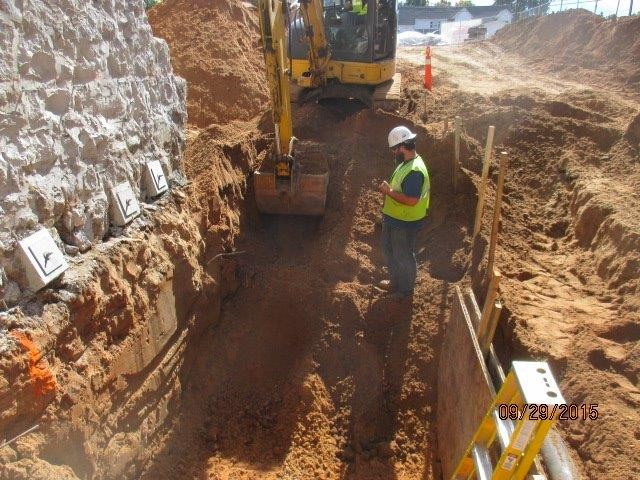
Good fit when:
the challenge
Excavation risk is often driven by what’s happening below grade — not at the surface
Below-grade construction becomes significantly more complex when the subsurface is working against the project. Soil structure, depth of cut, groundwater conditions, adjacent construction, superimposed loads, and seismic or vibration exposure can all influence excavation risk. When these factors overlap, the excavation itself becomes a geotechnical challenge — not just a construction sequence.
Common excavation risks
- Groundwater flow into or around the excavation
- Weak, loose, or disturbed soils that won’t hold an excavation face
- Adjacent structures or utilities sensitive to movement
- Limited stand-up time in soft or saturated ground
- Soil conditions that change with depth, weather, or water table
- Seismic loads, vibrations, or superimposed loading above the excavation
Why ground improvement enters the conversation
- Conventional earth-retention systems may not solve the soil problem alone
- Groundwater must be managed before or during the excavation
- Soil strength or permeability needs to be changed, not just supported
- Nearby assets need protection from excavation-related movement
- The excavation creates risk that surface-level solutions can’t address
how it works
Improve the ground so the excavation can proceed with greater control
Soil excavation support is generally centered on modifying the subsurface condition so that excavation can proceed with better stability, reduced water intrusion, and more reliable protection for adjacent structures and utilities.
Step 01
Evaluate subsurface conditions
Define how soil type, groundwater level, adjacent structures, and excavation depth are influencing risk. Identify whether the problem is soil strength, permeability, stability, utility exposure, or a combination of these.
Step 02
Select the grouting or ground-improvement method
Choose between permeation grouting (for water control and soil stabilization), jet grouting (for creating high-strength, low-permeability soil-cement elements), compaction grouting (for densifying soil), or a combination based on the excavation geometry and soil behavior.
Step 03
Improve the ground before or during excavation
Implement the selected treatment to stabilize soil, reduce water intrusion, support utilities, or create cut-off zones. This may occur ahead of the excavation sequence or concurrent with earth-retention installation.
Step 04
Excavate with greater control and reduced risk
With the subsurface improved, excavation can proceed with better stability, less groundwater interference, and more reliable protection for the surrounding environment.
Grouting Methods
Different ground conditions call for different approaches
Strucproof soil excavation support draws from multiple geotechnical grouting methods — each suited to different soil types, groundwater conditions, and excavation objectives. The right method depends on what the ground needs in order for the excavation to proceed safely.
METHOD 1
Permeation Grouting
Injects chemical or cementitious grout into the soil pore structure to increase strength, improve cohesion, or reduce permeability — without significantly displacing the soil.
- Water control in and around excavations
- Soil stabilization for excavation support
- Water cut-off barriers
- Utility and footing support
- Increasing stand-up time in soft ground
METHOD 2
Jet Grouting
Uses high-pressure, high-velocity jets to erode, mix, and replace soil with cement slurry — creating engineered soil-cement elements of high strength and low permeability.
- Excavation support columns or panels
- Groundwater control or cut-off walls
- Utility support during excavation
- Temporary or permanent soft-soil stabilization
- Structural underpinning
METHOD 3
Compaction Grouting
Injects a stiff, low-slump grout to displace and densify surrounding soil — increasing bearing capacity and reducing settlement risk in the excavation zone.
- Increasing bearing capacity near excavations
- Arresting or reducing foundation settlements
- Densifying loose soils ahead of excavation
- Improving support conditions for adjacent footings
Key Benefits
Create a more controlled excavation environment
Improves excavation stability
Helps the ground behave more predictably during below-grade work by strengthening soil and reducing water movement.
Manages groundwater
Permeation and jet grouting can create cut-off zones that reduce or control water flow into the excavation.
Protects adjacent structures
Reduces movement risk where nearby foundations, utilities, or structures are sensitive to excavation activity.
Increases stand-up time
Stabilized soils hold longer during excavation, improving safety and reducing schedule pressure.
Supplements conventional earth retention
Works alongside sheet piling, soldier piles, and other retention systems where ground conditions need more than structural support alone.
Temporary or permanent options
Solutions can be designed for either temporary excavation support or permanent ground improvement depending on the project need.
Typical Applications
Where soil excavation support may be considered
This solution is most relevant where subsurface conditions are creating excavation risk that conventional methods alone cannot fully address.
Excavations Adjacent to Existing Structures
Conditions where movement-sensitive buildings, foundations, or infrastructure sit close to the excavation and need better-controlled ground behavior.
Soft-Ground Tunneling Support
Subsurface conditions where soil must be stabilized ahead of or around tunnel excavation to increase stand-up time and reduce ground loss.
Groundwater Cut-Off Zones
Conditions where water must be controlled or blocked from entering the excavation through permeable soil layers.
Utility-Adjacent Excavations
Work areas where buried utilities need protection and support during excavation and backfill operations.
Weak or Saturated Soil Environments
Ground conditions where soil behavior must be improved before excavation can proceed safely and reliably.
The Strucproof Approach
Stabilize the ground before it destabilizes the work
step 01
Diagnose
Evaluate how soil type, groundwater, adjacent assets, and excavation depth are creating risk.
step 02
Design
Select the right grouting method and design the support strategy for the excavation and surrounding conditions.
step 03
Implement
Improve the ground before or during excavation using the selected method — permeation, jet, compaction, or combination.
step 04
Perform
Support safer, more controlled below-grade work through improved ground conditions and reduced excavation risk.
Need better ground conditions before excavation can proceed?
If groundwater, unstable soils, or adjacent-structure sensitivity are complicating an excavation, Strucproof can help evaluate the subsurface risk and determine the right ground-improvement strategy.