Negative-Side Damp Proofing (EOP)
Interior-applied moisture-control technology designed to reduce moisture transmission through concrete while supporting long-term durability and service-life performance.
Interior-Side Access
Designed for moisture-control conditions where interior application is preferred or required.
Moisture Reduction
Used to lower moisture transmission and content through concrete’s pore structure.
Steel Protection Benefit
Supporting material references cathodic protection of reinforcing steel.
Works with Other Solutions
Can be integrated into a broader moisture-control strategy.
overview
A negative-side moisture-control solution for chronic concrete dampness and water migration
Electro-Osmotic Pulse (EOP) is a negative-side damp proofing solution used to mitigate chronic moisture problems in concrete. It is described in the supporting material as a system that lowers moisture transmission and moisture content through concrete’s pore and capillary structure.
This makes EOP especially relevant where a structure is experiencing ongoing moisture migration, recurring dampness, or interior-side water-related performance issues, but where traditional exterior waterproofing access may be limited, disruptive, or impractical.
EOP can also be positioned as part of a broader moisture-control strategy when water intrusion, humidity, deterioration risk, and service-life extension all need to be considered together rather than as isolated issues.
Good fit when:
the challenge
Traditional damp proofing approaches don’t always solve the whole problem
Interior-side moisture problems can be persistent because they are driven by more than one condition at once: water pressure, moisture migration through concrete, crack-related pathways, and limited access for exterior-side repair.
Supporting material contrasts positive-side and negative-side systems and notes that traditional negative-side methods can be easier to apply and maintain from the interior, but can also come with limitations such as vulnerability to cracking, limited vapor control, and reduced protection in more demanding conditions.
Common Performance Challenges
- Moisture migration through concrete pore and capillary networks
- Interior dampness affecting finishes or space use
- Recurring leakage or chronic damp conditions
- Structures where exterior access is difficult after construction
Why EOP Enters the Conversation
- Works from the interior side of the structure
- Can be used alone or with other moisture-control solutions
- Addresses moisture transmission rather than only visible leak points
- May support long-term durability objectives
how it works
A system that uses an electric field to influence moisture movement through concrete
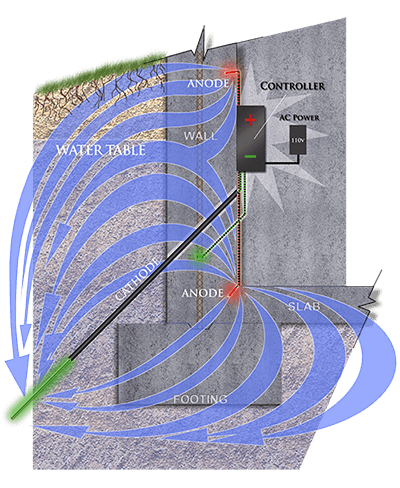
The EOP source material explains that the system creates an electric field between anodes and cathodes. The presentation states that anodes are embedded within joints and larger cracks, while cathodes are inserted in, through, or on the other side of the wall. It also explains that the electric field extends outward from the anode.
The same supporting material states that EOP creates an internal membrane of high osmotic pressure, helps protect crack repairs against hydrostatic pressure, and provides a reinforcement protection benefit.
Step 01
Locate the moisture problem
The solution begins with defining where moisture migration is occurring and whether the issue is chronic dampness, active leakage, or a broader water-management condition.
Step 02
Establish the EOP field
Anodes and cathodes are positioned according to the system design so the electric field can act within the concrete environment described in the source material.
Step 03
Reduce moisture movement
The system is described as lowering moisture transmission and content through the concrete pore and capillary structure.
Step 04
Support broader durability goals
Supporting material positions EOP as a strategy that can complement other moisture-control solutions and help extend service life.
Key Benefits
Benefits that go beyond simple interior sealing
EOP is positioned not just as an interior-side damp proofing option, but as a broader moisture-control technology that can support long-term structure performance.
Interior-Side Accessibility
Useful when working from the inside of the structure is the most realistic repair path.
Reduced Moisture Transmission
Supporting material states the system lowers moisture movement through concrete.
Reinforcement Protection Benefit
The source material references cathodic protection of steel reinforcement as part of the system advantages.
Compatibility with Other Solutions
EOP can be used alone or in conjunction with other moisture-control strategies.
Negative-Side Strategy
Provides a path for addressing moisture from the interior side rather than relying entirely on exterior access.
Long-Term Performance Focus
Supporting material describes the system as part of extending concrete service life.
Typical Applications
Where EOP may be considered
EOP is relevant for concrete structures with chronic moisture problems where interior-side access and long-term moisture management are key considerations.
Below-Grade Concrete Structures
Structures where interior dampness or moisture transmission affects performance, use, or durability.
Basements & Occupied Lower Levels
Spaces where moisture control is needed without depending entirely on exterior excavation or membrane access.
Parking & Commercial Concrete Environments
Concrete conditions where chronic moisture movement can contribute to deterioration and usability concerns.
Structures Requiring Integrated Moisture Strategy
Conditions where EOP may work alongside waterproofing, drainage, injection grouting, or crack repair.
The Strucproof Approach
A process built around diagnosis, design, implementation, and performance
The Strucproof framework supports a repeatable approach to complex moisture-control problems rather than treating them as one-off leak repairs.
step 01
Diagnose
Investigate and clearly define the moisture condition, leak path, and structure-specific challenge.
step 02
Design
Develop the right interior-side moisture-control strategy based on the diagnosis.
step 03
Implement
Install the system using trained crews and quality-controlled field practices.
step 04
Perform
Support long-term solution performance and service-life extension through a system-based approach.
Ready to Solve Your Waterproofing or Geotechnical Challenge?
Let our team diagnose the problem and engineer a solution built to last.