Water Management Solutions
Curtain Injection
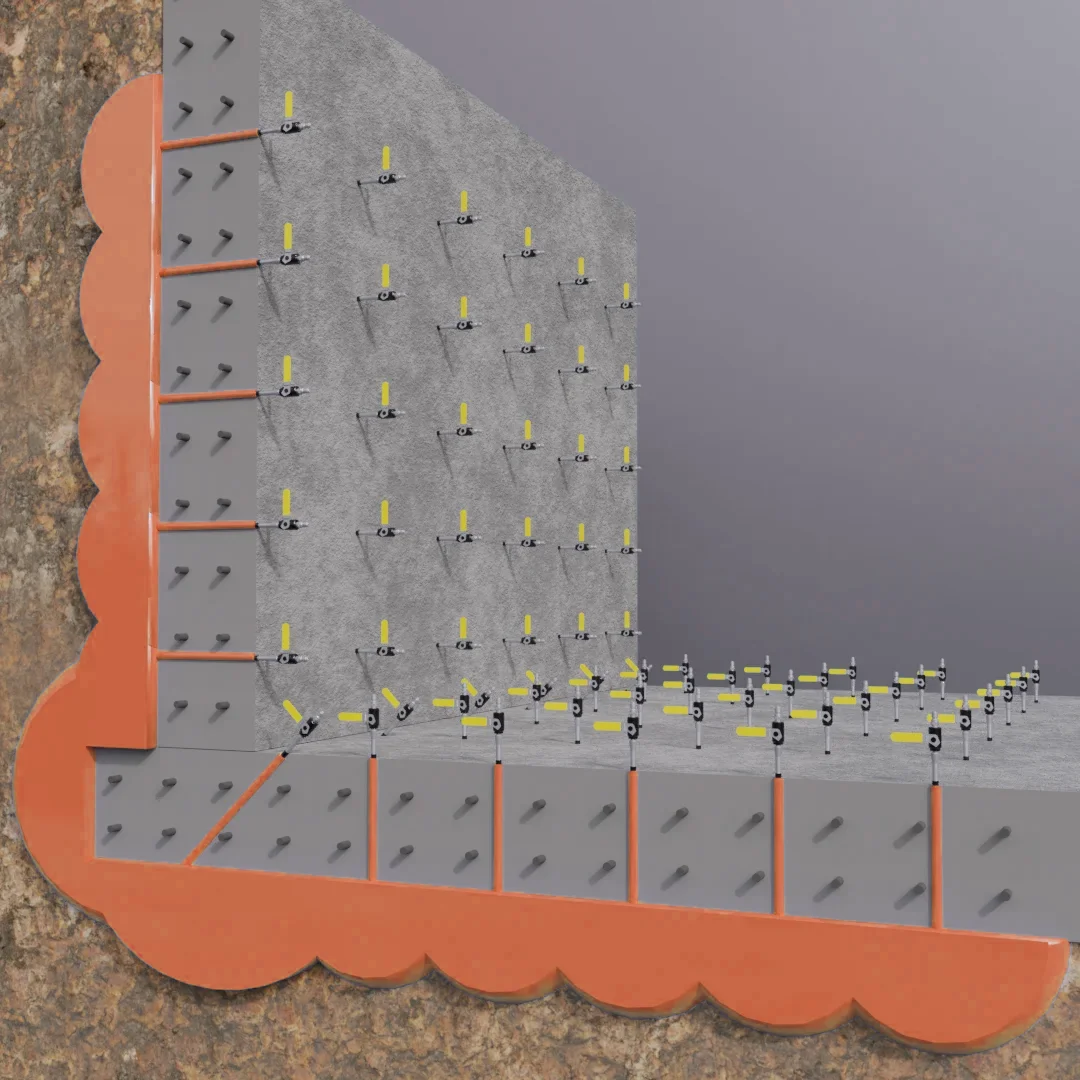
Subsurface injection of waterproofing grout materials to create a continuous barrier directly behind the structure wall or beneath the slab — sealing water intrusion from the blind side without exterior excavation.
Interior-Side Access
All work performed from within the structure — no excavation on the exterior required.
Barrier Creation
Forms a solidified grout zone or elastic membrane between the structure and the surrounding soil.
Concrete + Masonry
Effective through cast-in-place concrete, CMU block, brick, and composite wall assemblies.
Blindside Waterproofing
Creates water-control where the positive side of the structure cannot be accessed or excavated.
overview
When you can’t reach the outside of the wall, bring the waterproofing to the backside through the inside
Curtain injection is the process of injecting waterproofing grout materials through the structure — typically through a grid of drilled ports — to form a continuous water-control barrier on the blind (soil) side. The result is a solidified soil zone or elastic gel membrane just outside the containing structure that prevents water from reaching the interior.
In granular soils, a low-viscosity solution grout permeates the soil pore structure and forms a thickened, solidified zone adjacent to the wall or slab. In silty clay or non-permeable soils, the grout fractures outward from port to port, creating an interconnected barrier through fracture grouting (fracking). Either way, the objective is the same: create a continuous water-control curtain without digging up the exterior.
Curtain injection is frequently selected when exterior excavation is not possible, not practical, or too disruptive — such as adjacent roadways, active loading docks, utility-dense soil zones, occupied buildings, or deep below-grade structures where excavation cost and risk are prohibitive.
Good fit when:
the challenge
The leak is on the inside — but the source is on the outside
Below-grade water intrusion is driven by hydrostatic pressure pushing water through the wall, slab, or joint from the soil side. In an ideal scenario, you would access the exterior, repair or replace the waterproofing membrane, and control the water at its source. But in reality, that exterior surface is often buried, inaccessible, or surrounded by conditions that make excavation impractical.
Why the exterior can’t be reached
- Adjacent roadways, sidewalks, or active loading areas over the wall
- Utility-dense soil zones that cannot be disturbed
- Deep below-grade conditions where excavation is cost-prohibitive
- Occupied or operational buildings with no tolerance for exterior disruption
- Earth-retention systems (sheet piles, slurry walls) that block exterior access
- Tunnels, shafts, and underground chambers with no exterior face
Why interior-only repairs often fall short
- Surface coatings and sealants resist water from the wrong side
- Crack injection alone may not address the full leak path network
- Negative-side treatments don’t stop water from entering the concrete
- Water finds new paths once individual cracks or joints are sealed
- The hydrostatic source remains active and unaddressed
Materials & Equipment
Different grout materials for different soil types and performance needs
Curtain injection effectiveness depends on matching the right grout material to the soil condition, water pressure, joint geometry, and performance requirement. Strucproof selects from three primary material categories depending on the application.
material 01
Acrylic Gel Systems

Ultra-low-viscosity acrylic gels that permeate soil pore spaces, cure into a flexible and water-swellable barrier, and maintain elasticity over time. Delivered using injection lances with multi-directional tips. Three-component (A1, A2, B) formulation pumped with a plural-component injection system with integrated water flush.
- Below-grade wall curtain injection
- Brick and masonry mortar-joint sealing
- Tunnel, shaft, and void injection
- Soil stabilization adjacent to the structure
material 02
Polyurethane Gel Systems
Water-reactive polyurethane grouts that foam or gel upon contact with water, expanding to fill cracks, joints, and voids. Available in hydrophobic (water-displacing) and hydrophilic (water-absorbing) formulations depending on the leak condition and required flexibility.
- Active-leak curtain injection
- Joint and crack sealing in flowing water
- Void filling behind walls and slabs
- Rapid water shut-off applications
material 03
Cementitious Systems
Micro-fine cement and sodium silicate grouts used for soil permeation, strength development, and long-term durability. Higher viscosity than acrylic or polyurethane, but well suited for conditions requiring structural contribution or permanent soil solidification.
- Permanent soil solidification behind walls
- High-strength curtain zones
- Granular soil permeation
- Combined water control and ground improvement
Key Benefits
Seal the water source without digging up the exterior
No exterior excavation required
All work is performed from inside the structure — eliminating the need to dig up roads, sidewalks, loading docks, or utility zones above the wall.
Creates a continuous barrier
Creates a continuous barrier
Forms a solidified soil curtain or elastic gel membrane that functions as a new waterproofing layer on the blind side of the structure.
Addresses the source, not just the symptom
Stops water at the soil-to-structure interface rather than managing it after it has already passed through the wall or slab.
Works through concrete, CMU, and masonry
Effective through cast-in-place concrete, concrete masonry units, brick, and composite wall assemblies.
Adaptable to soil type
Permeation grouting in granular soils, fracture grouting in cohesive soils — the method adapts to what’s behind the wall.
Minimizes operational disruption
Interior-side access means the building can remain occupied and operational during the work — especially valuable in commercial, institutional, and infrastructure settings.
Typical Applications
Where curtain injection is commonly considered
Curtain injection is most relevant for below-grade structures where water intrusion is active, the positive side of the structure cannot be accessed, and the repair must be performed from the interior.
Below-Grade Walls & Foundations
Basement walls, foundation walls, and retaining structures where water is entering from the soil side and exterior access is restricted or impractical.
Tunnels, Shafts & Underground Chambers
Water ingress at joint locations, settling joints, and separation in tunnel linings where excavation is not possible and the structure surrounds the work area.
Slab-on-Grade & Sub-Slab Conditions
Upward-driven water through cracks, joints, or membrane failures in floor slabs — sealed by injecting beneath the structural slab into the appropriate interface.
CMU & Masonry Foundation Walls
Concrete masonry unit or brick foundation walls where water enters through mortar joints and hollow cores — sealed by injecting acrylic gel through the block into the backfill.
Parking Garages & Below-Grade Infrastructure
Multi-level below-grade structures where wall and slab leakage affects operations, MEP systems, or structural durability — often with no realistic path to the exterior.
Blindside Waterproofing Failures
Structures where the original positive-side waterproofing has failed, cannot be replaced from the exterior, and must be supplemented from the interior via injection.
The Strucproof Approach
Create the barrier behind the wall — without disturbing what’s in front of it
step 01
Diagnose
Identify the water source, map the leak paths, scan the structure for steel and thickness, and determine the soil type behind the wall.
step 02
Design
Design the injection grid, select the grout material, and define pressure, volume, and coverage parameters for the curtain.
step 03
Implement
Drill, install packers, and inject through a controlled grid pattern — monitoring grout migration, pressure, and coverage in real time.
step 04
Perform
Verify water reduction, seal ports, and support long-term barrier performance through proper material selection and quality-controlled installation.
Dealing with water intrusion you can’t reach from the outside?
If water is entering through a wall, slab, or joint that can’t be accessed from the exterior, Strucproof can help evaluate the leak path, select the right grout material, and engineer a curtain injection strategy that seals the source from the inside.